
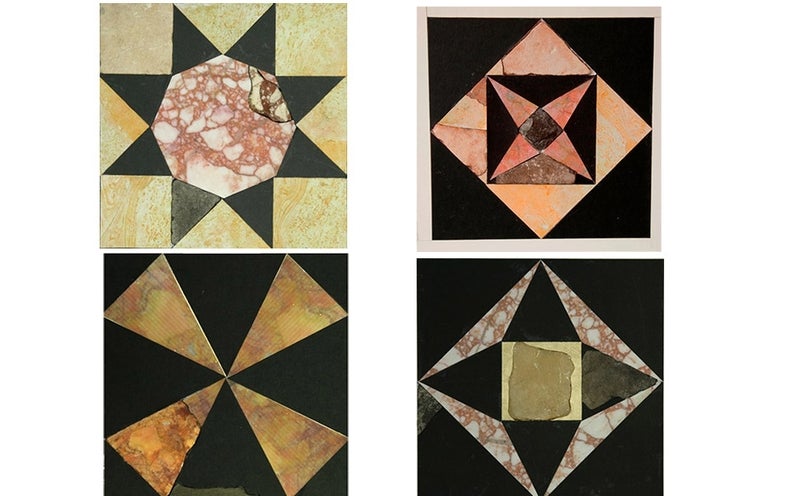
Archaeologists have completed the restoration of ornate
floor tiles which experts believe likely decorated the courtyard of the Second
Jewish Temple.
Why would proof be needed?
Denial of a Jewish connection to the Temple Mount began at the 2000 Camp David Summit, when the Palestinian Authority Chairman Yasser Arafat insisted - with no proof - that the Jewish Temple was actually near Shechem (Nablus), 30 miles north of Jerusalem, and not on the Temple Mount in Jerusalem.
The claim has since been taken up in the international narrative. UNESCO passed an initiative claiming the Temple Mount is an exclusively Muslim holy site. This claim went mainstream in October, 2015, when the New York Times published an article questioning whether the the temple mount was ever the site of either the first or the second temple. They retracted it the next day, but it was enough for the fake news crowd to pick it up.
The restoration of the floor tiles is proof that large expanses of the Temple Mount during the Second Temple were covered with a special type of ornate flooring called opus sectile, Latin for “cut work.” The idea was first put forward in 2007 by archaeologist Assaf Avraham, director of the Jerusalem Walls National Park. The new discovery confirms it.

The tile design is consistent with floors found in contemporary works built by Herod. Similar flooring has been found at Herod’s palaces in Masada, Herodium, and Jericho, among others. A key characteristic of the Herodian tiles is their size, which corresponds to the Roman foot (11.6 inches).
The find also agrees with Talmudic literature about the
construction of the Temple Mount which describes rows of green, blue and white
marble. The tile segments, mostly imported from Rome, Asia Minor, Tunisia and
Egypt, were made from polished multicolored stones cut in a variety of
geometric shapes.
Since the modern archaeological age began, the Temple Mount
has been off-limits, as it has been the site of the Muslim Dome of the Rock for
over a thousand years. However, Muslim construction projects occurred during
the years 1999-2000 that involved large scale earthworks using heavy machinery;
the purpose being to create an entrance to an area Jews refer to as Solomon’s Stables (an ancient
subterranean structure) which they were converting into a new mosque. In
addition, in an open area on the eastern side of the Temple Mount, ground
level was lowered with bulldozers in order to lay new pavement slabs. About 400
truckloads of rubble were removed and dumped in various locations, mainly in
the nearby Kidron Valley.
The earth-moving was done without building permits, and
without archaeological supervision. While mainstream archaeologists were
enraged at the destruction, Zachi Dvira, an archaeology student, came up with
the idea of collecting and sifting through all the rubble to see what was
there. Despite the lack of “context,” (being able to assign a time period to an
artifact based on the strata in which it was found) his thinking was that ‘something is better than nothing.’ The Sifting Project began in the Tzurim Valley
National Park in 2004.
- A bulla (a lump of clay impressed with a seal) reading “…son of Immer.” (See Jeremiah 20:1)
- Over 5,000 coins, including coins minted by the Jews during the revolt against Rome in 66 C.E..
- Terracotta figurines that appear to have been smashed on purpose. (2 Kings 23:24)
- Babylonian arrowheads.
- A small bronze harp that looks so much like the City of David logo that Israel now uses it in place of their own logo in some of their publicity.
- An amulet bearing the name of Egyptian pharaoh Thutmose III
Feel free to leave a comment.
Check out my latest novel:

