Showing posts with label last days. Show all posts

Wednesday, July 1, 2020

Hard Things in the Bible, Part 3: Revelation


The book of Revelation or Apocalypse certainly qualifies as one of the ‘hard things’ of the Bible. But don't leave! I promise, we can make some sense of it.
Revelation is full of prophecies and symbolism. That shouldn’t surprise anyone: Revelation tells you, right at the beginning, that it was written in symbolism:
Rev. 1:1 “The Revelation of Jesus Christ, which God gave Him to show His servants the things which must shortly take place. And He sent it and he symbolized it when he sent by his Angel to his Servant John.”

The Greek word rendered 'symbolized' can also be translated as 'signified' or 'in or with signs'. 

As we pointed out in part 1 of this series, opinions are a dime a dozen... everybody has them, and they all have the same value: zero. The only way to know for sure that your understanding of a hard Bible passage is on the mark is to compare it to other parts of the Bible.  So that’s how we’re going to go about this.

Before we get to the individual symbols, we need to understand when to look for these signs or symbols. Does Revelation answer that? 
 Rev. 1:10 “In the Spirit I found myself present on the day of the Lord.”
John’s use of the term “Day of the Lord” did not mean Sunday, despite some really bad translations that render it that way. Sunday didn’t have any special significance until hundreds of years after John died and even then, it was part of Catholicism’s attempt to overwrite pagan ideas. 
But there are other biblical references to a special future “day” of the Lord. 
Revelation 1:10 uses the Greek word "en". The first definition of en is ‘in’, not ‘on’... John's visions happened "in the Lord's day", not 'on the Lord's day'. What's the difference? When we are being specific we say ‘on such and such a day’, but when we are referring to a time period, we say “in”: ‘In my grandfather’s day’, for example. The Bible does the same:
 “Just as the days of Noah were, so the presence of the Son of man will be. For as they were in those days before the Flood, eating and drinking, men marrying and women being given in marriage, until the day that Noah entered into the ark, and they took no note until the Flood came and swept them all away, so the presence of the Son of man will be.” (Matthew 24:37-39)
So in Revelation 1:10,  because it says "in", not "on", 'the Lord's day’ means a time period, not a single day. What time period, then, did John mean by "the Lord's day"?
In the passage just quoted, Matthew 24:37, Jesus refers to that time period of the last days preceding the Flood as a parallel to his future presence
(By the way, if your Bible says “coming” instead of “presence” in these passages in Matthew, you need to get a better Bible. The Greek word in all these places is parousia, from which we get our English word “presence”... It even has a P, an R, and an S, just like “presence.” The Greek word for “coming” is erkhomenon; and the fact that the root part of that word, ‘khom’, sounds a lot like the English word “come” is not an accident, either.)
Jesus' often warned of a future day of reckoning. 
“Many will say to me in that day: ‘Lord, Lord...” (Matthew 7:22)
“Just as lightning flashes from one part of heaven to another part of heaven, so the Son of man will be in his day.” (Luke 17:24) Note the parallel account in Matthew: “Just as the lightning comes out of the east and shines over to the west, so the presence of the Son of man will be.” (Matthew 24:27)
So when John says that in some spirit-assisted way he found himself ‘in the Lord’s day’, it is reasonable that he was speaking about seeing visions of Jesus' future presence... some future, pre-Armageddon period of time.
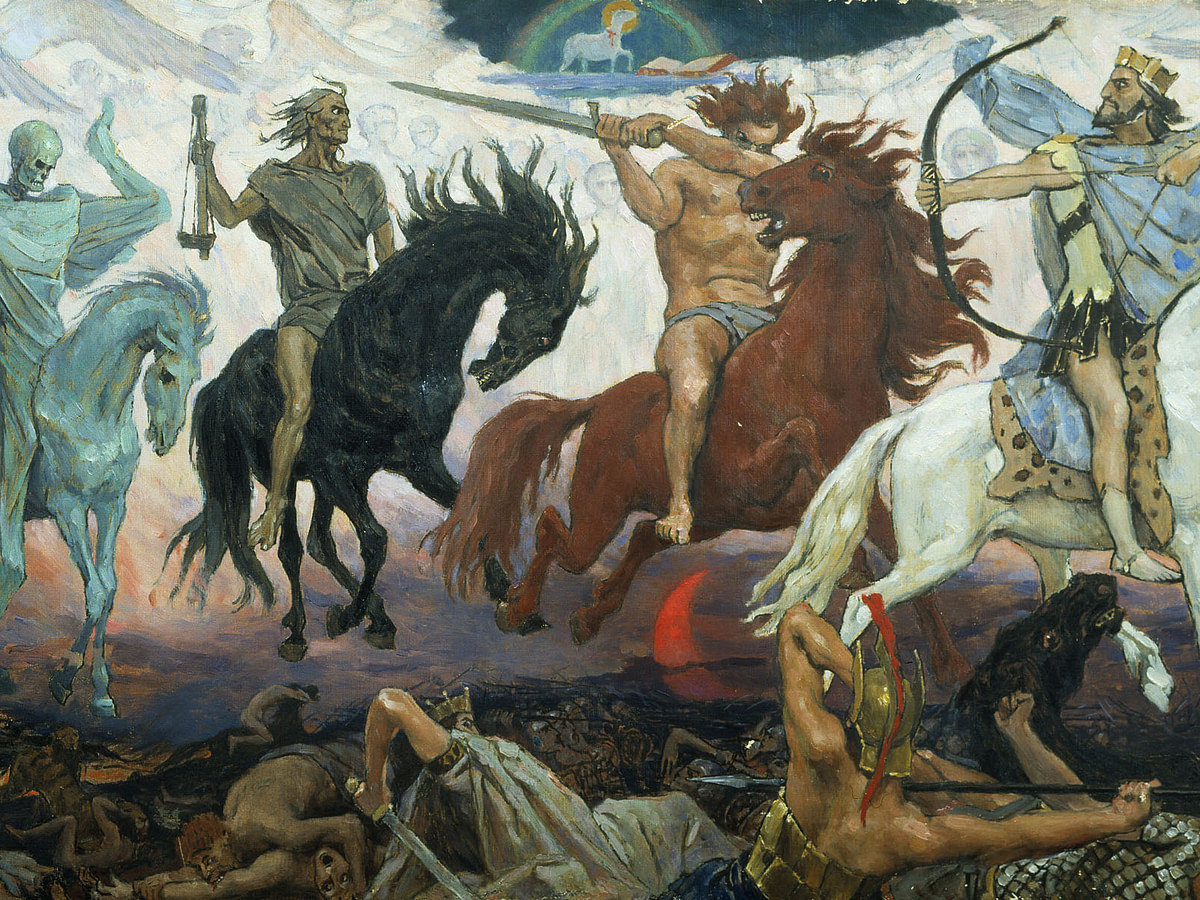
If further proof is needed, John’s description of the ‘horsemen of the apocalypse’ in Revelation chapter 6 includes war, famine and pestilence – the same signs Jesus told his apostles, in Matthew 24, would mark the period called 'the last days'.
What has confused some readers of the Revelation account is that the first horse out of the gate is the white horse, and his rider is armed with a bow, given a crown, and described as heading toward a conquest. 
People want to equate that picture with Armageddon, but it almost seems backwards. After all, if the white horse and the crowned rider refer to the 'thy kingdom come' we've all prayed for, why is it immediately followed by war, famine and pestilence? Billy Graham even went so far as to claim that the rider on the white horse couldn’t possibly mean the establishment of Jesus’ kingdom; It had to represent some false kingdom.
If you're struggling to support your pioneer lifestyle, maybe this will help: "99 Ways to Fire Your Boss" is a huge collection of income ideas, plus powerful suggestions for lowering your cost of living! Look for it on Amazon.com in paper and electronic versions.
He and several other Bible commentators, however, are leaning on their own interpretation instead of using the Bible to understand the Bible. Matthew 24 is undeniably discussing the same events as pictured by the horsemen of Revelation 6. Matthew 24:3 reads: "The disciples came near to him by himself, saying, `Tell us, when shall these be? and what is the sign of thy presence, and of the full end of the age?'"
The answer Jesus gave was that his presence would be characterized by many bad things that would begin happening on Earth.  So yes, the establishment of Jesus’ kingdom - the beginning of the ride of the white horse - doesn’t happen at Armageddon. It happens prior to, and then is immediately followed by bad things, rising to the crescendo of Armageddon.
Another vision within Revelation makes exactly the same point:
“War broke out in heaven: Michael and his angels battled with the dragon, and the dragon and its angels battled but they did not prevail, nor was a place found for them any longer in heaven. So down the great dragon was hurled... On this account be glad, you heavens and you who reside in them! Woe for the earth and for the sea, because the Devil has come down to you, having great anger, knowing that he has a short period of time.” (Revelation 12:7-12)

Again, we see a reference to a period of time, marked by ‘woe for the earth’, that precedes the climax which will spell the end for Satan.
Of course, there’s way too much to the book of Revelation to discuss in a short article like this one. In coming discussions we’ll deal with some of the individual symbols, characters, beasts, and numbers.
 Please feel free to Share this, leave a comment, and subscribe. Click here for Part Four of this series.
 
Check out my latest novel:
 
Bill K. Underwood is a columnist, consultant, photographer and author of several bible-friendly novels available at Amazon.com. You can help support this site by purchasing one of his books.


Friday, April 17, 2020

Is Food Shortage Next?


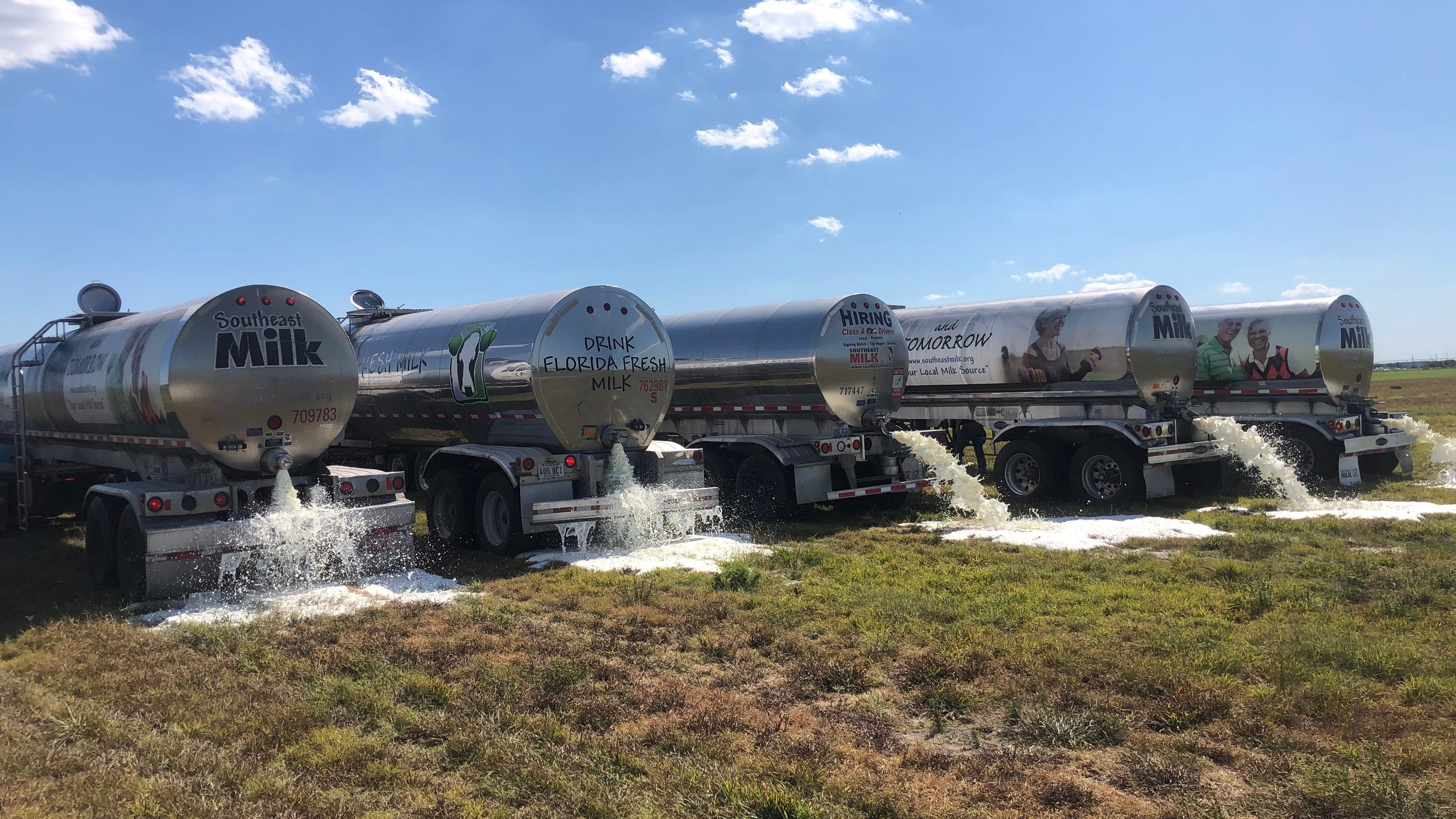
Perhaps you saw, early in the pandemic, some of these stories of dairy farmers dumping milk down the sewer, or vegetable farmers plowing their crops under. Why did that happen? 

Storage is expensive. Cold storage is especially expensive. Over the past few decades, with the help of the almighty computer, supply chains have cut margins to a razor-thin edge. A product goes from its source to its consumer with as short a wait as possible, to save on warehousing costs.

Before the pandemic began, the average American ate out at a restaurant six times a month. 6 meals out of 90 = about 7%. Just because I hate math, let’s round it 5%. So 5% of the food produced in this country is no longer being consumed. “Wait!” I can hear you saying. “People who stop eating out still eat." True. But the farmers who are part of the supply chain for restaurants can't just turn around and sell their food to grocery stores.  

The food at most restaurants doesn't come directly from the farmers. It comes from large restaurant supply corporations, such as Sysco. It comes in restaurant-sized packaging. There is simply no space on grocery store shelves. When restaurants close and stop accepting deliveries from Sysco, Sysco has to tell their farmers, Stop, we don’t have any place to put your produce. What is the farmer supposed to do with it? They operate on tight margins as it is, because Sysco doesn't pay them much. Redirecting their crop to grocery store suppliers would have cost them more than the crop was worth. Some of them couldn't even afford to deliver it to food banks. So they dumped it. 

Now, here’s where it gets tricky. That 5-7% number mentioned earlier; that doesn’t represent every person eating out 6 times a month. Some households eat out nearly every meal. So when the restaurants closed during the pandemic, those households pivoted to eating pre-cooked meals – things like Swanson TV dinners. 

Couldn’t the Swansons of the world take the restaurant’s excess off the hands of the farmers? Eventually, yes. But the switchover took time. The Swanson-type companies already have their own supply chain, and it doesn’t include potatoes prepared to be Red Robin’s signature steak fries.
So closing the restaurants spiked the pre-made meals market. When masked shoppers went to Safeway to stock up on Hungry Man dinners, and that particular case was empty, what do they do? They buy their second choice. 
 
And of course they buy more than they need, "just in case." And the supply chain isn't built to account for that, either.

A section of the population also tried to dust off their cooking skills. When was the last time you baked bread? Early on, when toilet paper was being hoarded, bread was also in short supply in some stores. So people started stocking up on flour and Googling how to bake their own bread. That resulted in a flour and yeast shortage, which drove up prices. The price of hamburger in the meat department rose as well; all these new experimental cookers were more confident in their ability to cook a burger than a roast.

The shortages by and large did not reach starvation levels. But the price per ounce of food definitely rose faster than other parts of the economy. And even after the pandemic was in the rear view mirror, a new virus affecting birds caused farmers to destroy over 23 million chickens. So the price of eggs goes through the roof. News of shortages and sharp spikes in prices of some foods, such as chocolate, have become commonplace. Humans are amazingly adaptable; what causes alarm one day is ho-hum the next.
 
And that is a problem.

Isn’t it interesting that this type of food shortage is exactly what the Bible predicted? Revelation 6:6, in describing the ‘end times’ or last days, said: 
  • “I heard a voice out of the midst of the four living creatures say, ‘A quart of wheat for a day’s wage, three quarts of barley for a day’s wage, and do not harm the olive oil or the wine.’”

In Bible times, as today, wheat was preferable to barley. A quart of wheat would not have been enough for a small family to subsist on, certainly not something you'd want to spend your whole day's wage on. So that heavenly voice was predicting, not necessarily starvation, but at the very least shortages and price gouging, having to make do with what may not be your preference. Olive oil and wine were staples as well. Olive oil was used for everything from lamplight to lotions. The admonition to not harm them would indicate having to take special care to preserve what you have. 

Food shortages alone, or even food shortages accompanying a pandemic, are not proof that we are living in the last days. That’s why Jesus gave a multi-part sign. But what we are seeing should be enough to make a reasonable person investigate further. If you haven’t done so in a while, re-read Matthew 24 & 25, Luke 21, Mark 13, 2 Timothy 3, and Revelation chapter 6.

Click here to read another column about the Sign of the Times. Please feel free to leave a comment.  
 
Check out my latest novel:
 
Bill K. Underwood is a columnist, photographer, and author of several books, available at Amazon.com. You can help support this site by purchasing one of his books.


Thursday, July 7, 2016

Are things actually getting better?


“There are Lies, Damned lies, and Statistics.”
Mark Twain attributed that remark to Benjamin Disraeli, but there is no record of Disraeli’s ever having said it. Perhaps it was one of Mark Twain’s ‘lies.’ A commenter on my previous column, however, has made great use of statistics.

"Things have always been this way!"


A 2013 poll asked: ‘Do you feel things are getting better, staying the same, or getting worse?’
Back then, only 42% responded that it was getting worse. 
In a poll of Americans in 2025 that asked the same question, 65% answered that things are getting worse, and only 6% answered that things are getting better.  
 
A commenter on my column about the UN attacking religion said: “The predictions of end times have been going on for 2000 years. The end is eternally nigh. 10,000 years from now, you guys will still be saying it's the end times.”
 
This guy probably doesn’t know it, but he just fulfilled another prophecy about the end times. 
2 Peter 3:3,4 says: 
“In the last days scoffers will come who make a mock at everything--men governed only by their own passions, and asking, "What has become of His promised Return? For from the time our forefathers fell asleep all things continue as they have been ever since the creation of the world."
 The last time I flew, I couldn’t help thinking about the first time I flew…1968, Portland to Honolulu. It was a big deal. I wore my best suit. We walked up to the counter, displayed our tickets, and were ushered onto the plane by a couple of the most gorgeous women I’d ever seen, wearing reassuring smiles and confidence-inspiring Pan Am uniforms. I hung on their every word as they explained how to buckle and adjust the seat belt, and about using the seat cushion as a flotation device in the event of a water landing.
 
There were no x-ray machines, no luggage searches, no metal detectors, no pat downs. There were no announcements about not leaving your bags unattended, no bomb-sniffing dogs; no one asked if I’d packed my bag myself.
 
The last trip was much different. First was all the folderol of getting through security at Sky Harbor… the long zig-zag line, shoes off, belt off, hold your pants up with one hand while taking everything out of your pockets with the other, put your laptop in a separate bin, no liquids more than 3 ounces, all liquids in a separate see-through hold-all… They waved through the guy in front of me who was carrying a 5-foot hickory walking stick with knobs on it. If he was – as I believe – Chuck Norris traveling incognito, he could have used it to take out the entire flight crew and half the passengers. But if I had an 8 ounce bottle of Pepto-Bismol, that was a security risk.
 
But wait, there’s more. Step into the Pro-vision L3 Millimeter Wave Scanner, hands up, (but don’t drop your pants.) My wife’s hearing aid created some sort of alert that prompted a guard to grope her chest while another waived a wand over the back of her head. I waddle over to collect my shoes, belt and flash drive – did I mention my flash drive had to be scanned again? Must be an even bigger threat than the Pepto – then walk barefoot over 50 yards of e coli- and Legionella-infested carpet to get to a bench Homeland Security has thoughtfully provided for humiliated passengers to retie their shoes and try to recover their dignity.
 
During the pre-flight safety briefing, someone remarked that anyone who doesn’t know how to use a seat belt shouldn’t be allowed to fly, and his seatmate replied that (as we were flying from Phoenix to Atlanta) if we had to deal with a water landing we had much bigger issues to think about that using the seat cushion as a flotation device.
 
How did we get to this point? Worse, how did we get to where people seem to think that this is just a temporary inconvenience, or worse still, that this is perfectly normal behavior
Does mankind really think things are going to turn around? Do they think that somehow the terrorist threat will be neutralized? Or that science will come up with a simple, non-intrusive foolproof scanner that will be able to take out the bad guys before they can even come to the airport?
 
Perhaps things are NOT going along ‘exactly as they have been ever since the creation of the world.’
 
In 1956 Dad bought a new Chevy. It featured a handle around the ignition, which was marked ‘Lock, Off, On, Start.’ A person could turn the handle to Lock and remove the key, and that was considered a sufficient theft-deterrent. However, you also had the option to turn the handle to ‘Off,’ remove the key and toss it on the dresser, and start the car with the handle alone, as my folks did for the next two years before trading it in for a new car (something else single-income households can't do anymore, but that's a different discussion.)
 
Which begs the question: Why would GM build a car in 1956 that needed no key? If things are no worse today than they were in 1956 why are cars now built with security systems that rival missile launchers? With features that, if you forget to arm them, will arm themselves? Is it because car manufacturers needed more features to sell? Or is it because the rate of car theft went up?
 
The top disciplinary problems in school in the 1940s and 1950s included chewing gum, running in the halls, and cutting in line. Today that list would include teen pregnancy and sexually transmitted diseases, drug abuse, teacher abuse, mass-shootings, and suicide. Again, does anyone believe these changes are temporary?
 
Medicine has made amazing advances, but people are sicker than ever. Science has figured out ways to triple and quadruple crop yields, but a billion people still go to bed hungry each night. There are more starving people today than there were in the last great famine.
 
And those of us who are not starving are malnourished: we stuff ourselves with nutrient-deficient Big Macs, trans-fat fries, genetically modified soy protein, estrogen-enhanced milk, and hormone-altered chicken nuggets.
 
People's morals have changed. The novel "50 Shades of Grey" was described as 'soft-porn for women', yet it broke sales records. Some reviews of the movie complained that it wasn't raunchy enough. Movies have to keep pushing boundaries if they want to keep selling tickets to an increasingly jaded public. Bumper stickers that used to bear warm fuzzy messages like "visualize whirled peas" have been replaced by slogans such as "Don’t honk, I’m reloading as fast as I can." And unfortunately, there’s more truth than poetry in the latter. Your grandmother’s world didn’t include phrases like “going postal” or “road rage.”
 
If you do not believe these are the last days, how bad do things have to get to convince you?
 

 Check out my latest novel:
 

Bill K. Underwood is a columnist and author of several books. You can help support this site by following the link here to his books on Amazon.com.